Lifedata.ai

Lifedata.ai

Lifedata.ai

End-to-end UX improvement and visual identity refresh for Lifedata.ai, simplifying a complex AI platform without compromising its functionality.

Services

product design

Branding

Team

8 People

Table of contents

(05)

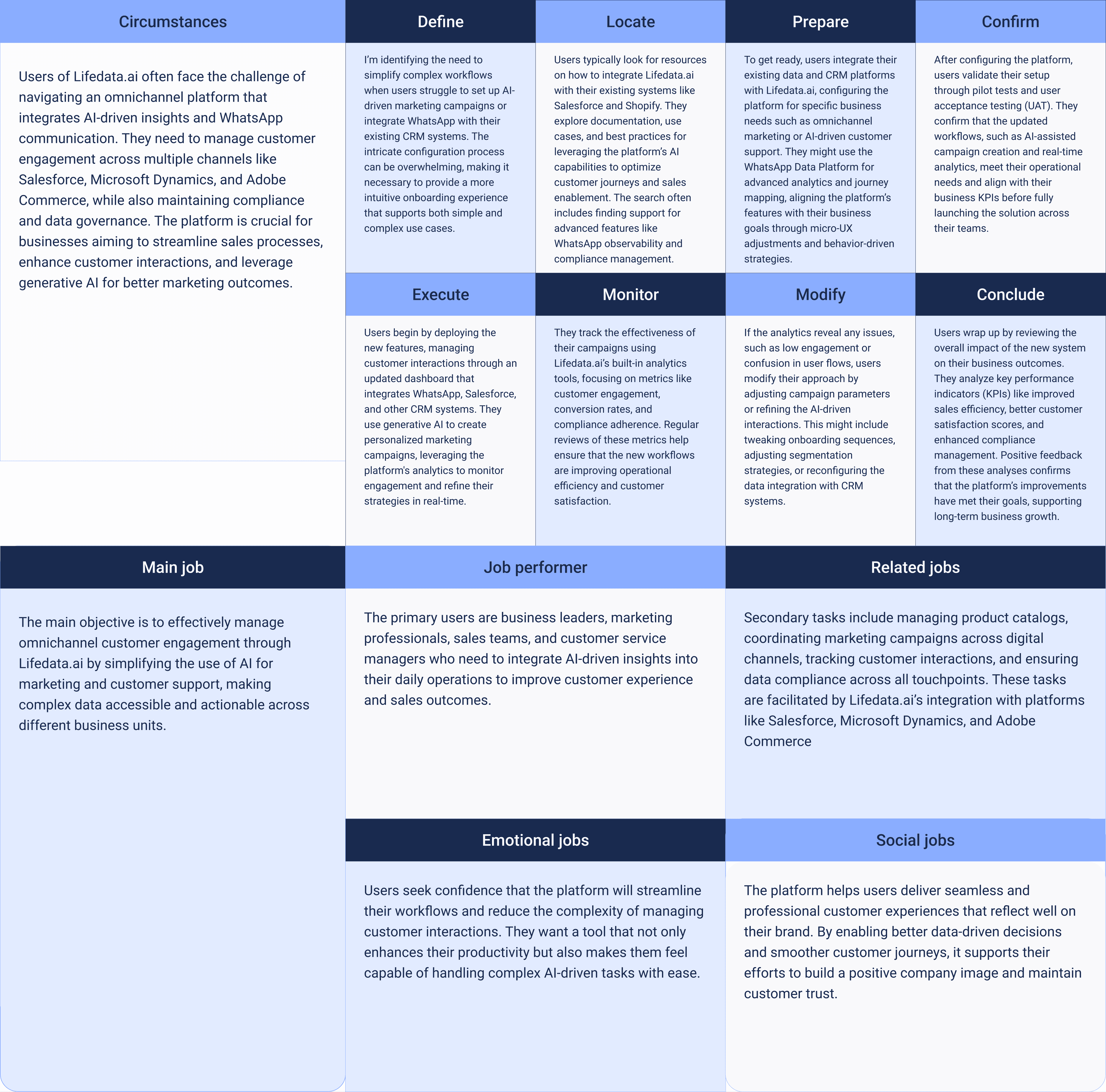
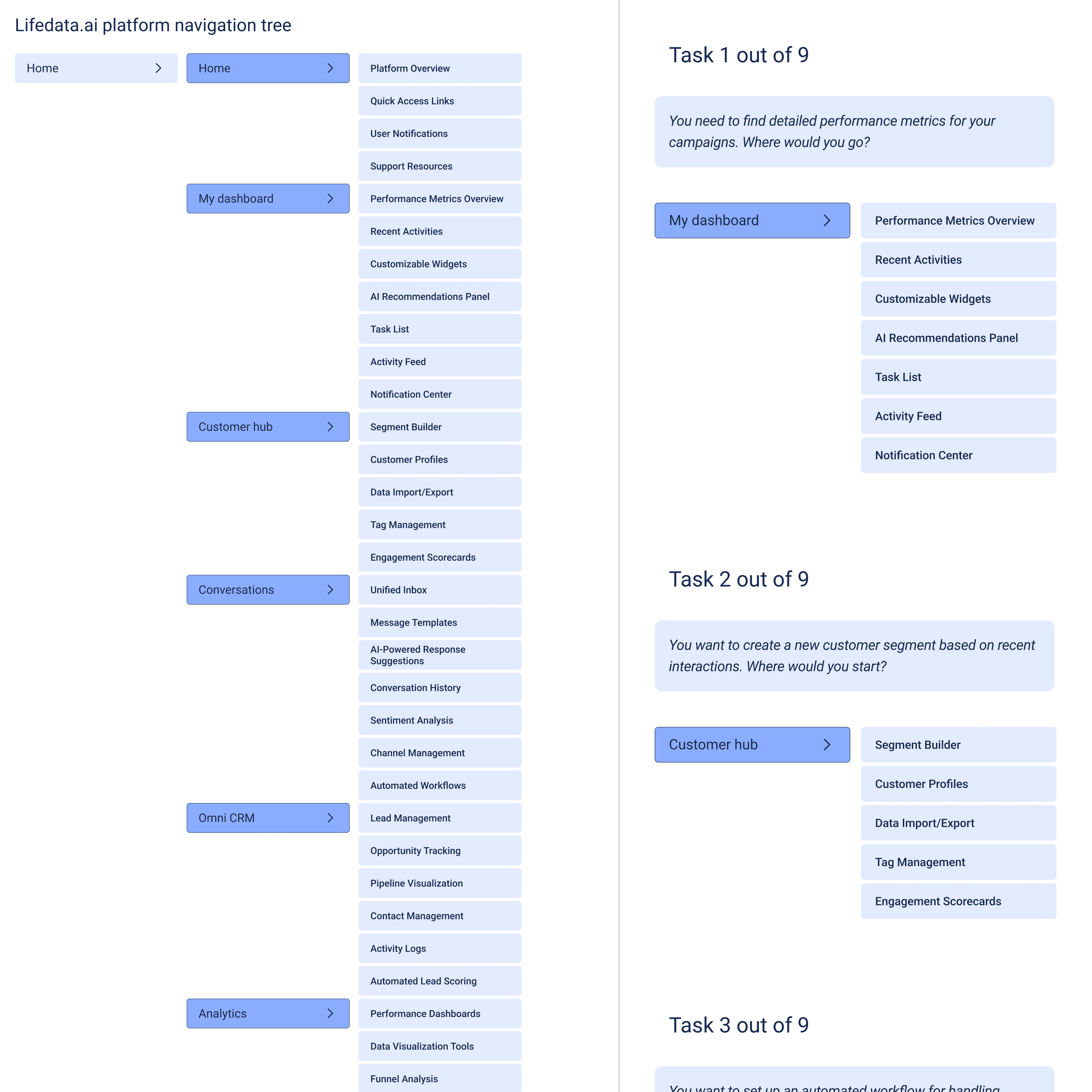
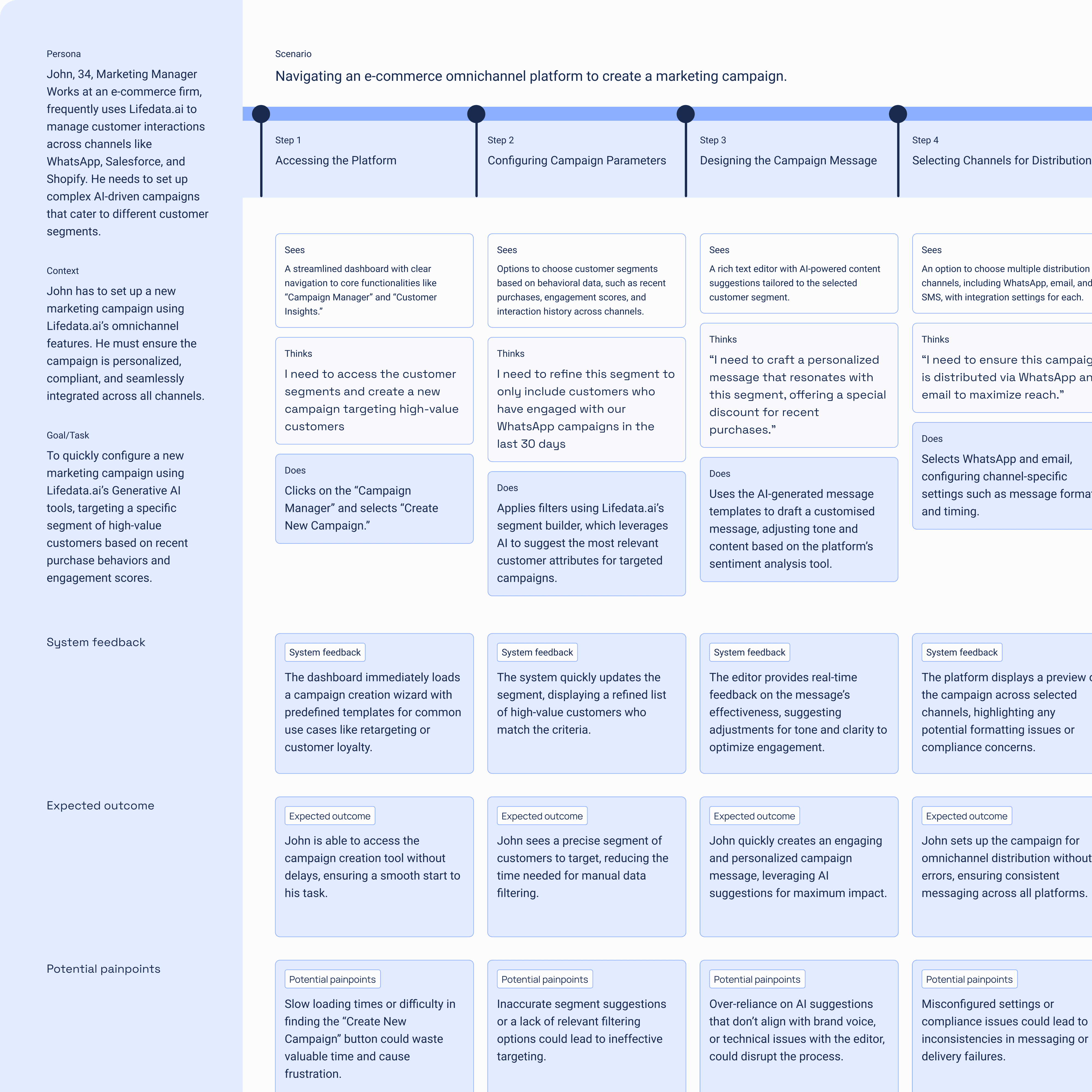
Before redesigning anything I ran a heuristic evaluation to understand exactly what was broken and why. The navigation was carrying too much complexity, the AI assistant had no clear entry point, and friction across onboarding and campaign flows was losing users before they reached the product's value. I restructured the navigation, redesigned the core flows, and used tree testing to confirm the new structure held up before development began. Jobs-to-be-Done shaped the personas and scenarios that grounded the work throughout, and close collaboration with the team made sure every change served both user needs and business goals. The platform came out simpler, faster, and better aligned with what users came to do.

Before redesigning anything I ran a heuristic evaluation to understand exactly what was broken and why. The navigation was carrying too much complexity, the AI assistant had no clear entry point, and friction across onboarding and campaign flows was losing users before they reached the product's value. I restructured the navigation, redesigned the core flows, and used tree testing to confirm the new structure held up before development began. Jobs-to-be-Done shaped the personas and scenarios that grounded the work throughout, and close collaboration with the team made sure every change served both user needs and business goals. The platform came out simpler, faster, and better aligned with what users came to do.

Navigate the Omnichannel Experience: Live

Navigate the Omnichannel Experience: Live

01

UX Research

UX Research

The research phase opened with a structured stakeholder interview with Purple Unity's CEO, covering background, goals, challenges, and success metrics. It revealed three priorities that shaped everything that followed: scalability above all else, a brand that communicated innovation and environmental responsibility without becoming too abstract, and a design system modular enough to onboard enterprise clients without requiring rework every time a new feature shipped. A service design blueprint mapped the full customer journey across four stages — from first awareness through to post-delivery feedback — and exposed onboarding as the highest-stakes moment in the entire experience, sitting at the intersection of the most customer actions, the longest time investment, and the most backend complexity. A Kano model analysis across 20 features then drew a clear line between what Purple Unity had to ship and what would define its long-term competitive position, with security, API-first integration, payments, accessibility, and core onboarding flows confirmed as the non-negotiable foundation. The information architecture brought all three streams together into a single structure built around how enterprise asset managers actually think rather than how the platform was technically organized.

The research phase opened with a structured stakeholder interview with Purple Unity's CEO, covering background, goals, challenges, and success metrics. It revealed three priorities that shaped everything that followed: scalability above all else, a brand that communicated innovation and environmental responsibility without becoming too abstract, and a design system modular enough to onboard enterprise clients without requiring rework every time a new feature shipped. A service design blueprint mapped the full customer journey across four stages — from first awareness through to post-delivery feedback — and exposed onboarding as the highest-stakes moment in the entire experience, sitting at the intersection of the most customer actions, the longest time investment, and the most backend complexity. A Kano model analysis across 20 features then drew a clear line between what Purple Unity had to ship and what would define its long-term competitive position, with security, API-first integration, payments, accessibility, and core onboarding flows confirmed as the non-negotiable foundation. The information architecture brought all three streams together into a single structure built around how enterprise asset managers actually think rather than how the platform was technically organized.

02

Design System

After the UX research, I started to create a full-fledged atomic design system. I also created a component for every element on the screen that was repeated twice or more. I moved from one user flow to another, creating a cohesive and logical system. After I had the full scope of the platform, I started designing high-fidelity prototypes. For the brand, I started with the mind map. Then I designed the logo, selected typography and colors, and moved into writing principles, voice & tone. For the website, I laid down IA, designed sections and put down all the content, before creating visual language. I moved in iteration circles and added new features, pages and elements as they came up.

03

Final Designs

The platform, brand, and website each presented their own design challenge. In the platform, the auction engine pushed the design system furthest — a real-time interface where active auctions, incoming bids, buyer analytics, and asset performance data all competed for attention on a single screen. I resolved the tension by building a strict information hierarchy into the component structure, letting the density serve the user rather than overwhelm them.

The brand took a different kind of risk: choosing 3D illustrations and icons over the flat design language most competitors defaulted to, giving Purple Unity a visual identity that felt distinctive and premium from first impression. The website tied it all together, designed and written from IA through to final visual language, with all three workstreams continuing to evolve iteratively as the product grew.

04

Conclusion

Building Purple Unity involved a balance of research-driven decision-making and creative execution. Starting with the platform’s design, I implemented a robust, atomic design system that could handle rapid iterations and updates. I used tools like the Kano model and information architecture to prioritize and refine the user experience. The branding came next, where I crafted a logo, visual identity, and a comprehensive brand system that reflected Purple Unity’s values of innovation and sustainability. By the end of the project, we had created a scalable platform and a strong brand that stood out in the asset management industry.

Building Purple Unity involved a balance of research-driven decision-making and creative execution. Starting with the platform’s design, I implemented a robust, atomic design system that could handle rapid iterations and updates. I used tools like the Kano model and information architecture to prioritize and refine the user experience. The branding came next, where I crafted a logo, visual identity, and a comprehensive brand system that reflected Purple Unity’s values of innovation and sustainability. By the end of the project, we had created a scalable platform and a strong brand that stood out in the asset management industry.

More works

Dev Tool

A platform for orchestration

Dev Tool

A platform for orchestration

Lifedata.ai

A platform for Omnichannel Customer Experience.

Lifedata.ai

A platform for Omnichannel Customer Experience.

Contact me

I Am All Ears!

Contact me

I Am All Ears!

Contact me

I Am All Ears!

The kind of a designer that feels like a keeper.

The kind of a designer that feels like a keeper.

The kind of a designer that feels like a keeper.